














"Turning the Writing Workshop Model
on Its Head: 'The Ossmann Method'”
For many years now, I have
been teaching employing a non-traditional workshop model that creates such a positive
learning experience I’d like to share it. I know from talking with colleagues
that I’m not alone in my desire for a new creative writing workshop model.
Throughout my undergraduate and graduate years, I was dissatisfied with the
traditional creative writing workshop model without knowing exactly why. It
wasn’t until I’d been a professional editor for a few years that I identified
what bothered me and developed a method to address it. I first taught it in
2005, for a Maine Writers & Publishers Alliance weekend workshop seminar,
and called it “Thinking Like a Poetry Editor: How to Be Your Own Best Critic.”
Since then it has been suggested to me several times that I call it the
“Ossmann Method,” which suggests to me that I have something worth sharing.
The traditional model, wherein
the writer being critiqued sits silently during the process, is a sometimes
more and sometimes less positive model, depending on the teacher’s emphasis
(what isn’t working in the writing vs. what is, the level of tact, etc.). The
dynamic, in my experience as both writer and teacher, is always a
dependent, disempowering one for the writer who sits silently, being instructed
as to how to improve. It was in joining my desire to teach writers how to be
more objective in revising their own work (by learning to think more like
professional editors) and my desire to create a workshop model engendering
self-discovery, self-confidence, self-trust and true collegiality, that I first
imagined a workshop format that effectively reverses both the traditional model
and its controlling dynamic.
I have taught using
this model regionally, in Vermont and New England, and nationally.
Its effect has been dramatic for participants (some of whom have asked for
permission to use the model in their own workshop teaching):
Thank you for your words
about my poems. I must tell you that Saturday had such an impact on me,
that I'm ‘seeing’ them and ‘working’ on them as per the critiquing
discussion—word choices, deletions, etc. This hasn't happened to me
before as the result of any
workshop...I've always thought of this as incubation, but this after-effect is
purposeful and focused. It is excellent discipline before hitting the
keyboard— or putting pen to paper. Thank you again! —Peggy Sapphire
Here’s how the method works:
I begin workshops by asking
each participant to describe—instead of giving their bio—one of their writerly
obsessions: a stylistic technique or poetic or prose device, a favorite word or
image, theme or subject. Participants enjoy this and it is a good first step in
learning to observe themselves as writers.
I turn the traditional
workshop model on its head by asking the author being critiqued to speak first
and critique her/his own work, noting correlations between the criticisms s/he
has for other participants’ works (written down in advance of the workshop) and
her/his own before group discussion of the work begins. This offers a taste of
what it means to be both writer and editor, a position in which it becomes easier
to objectively self-assess—and harder to ignore the need; to spot dull vs.
energetic syntax or dialogue, generic vs. original imagery and other strengths
and weaknesses previously overlooked. It also empowers the writer in the
process, and engenders an unusually positive and congenial workshop
environment.
Advance preparation by the
participants is required for the success of this model, and so far, students
have found the preparation valuable and instructive. It is in performing this
work that the student first begins to learn editorial objectivity about their
writing:
PARTICIPANT ADVANCE
PREPARATION
Please read, critique and
annotate other participants’ work before attempting to critique your
own, and use the notes to inform your critique of yours.
Please prepare tactful,
written comments to offer verbally to other participants, listing a minimum of
two strengths and weaknesses for each work. It is as important to learn your
strengths as it is to learn your weaknesses, otherwise you risk succeeding only
by accident. After you have finished this, please do the same for your work.
Please bring your annotated copies
of participant work to give to the authors.
Some suggested strengths/weaknesses to look for in preparing for workshop (the following list includes both poetic and prose techniques, and many apply to both genres):
Author Self-critique
Group (and teacher) response
A final word about “the Ossmann Method”: because the writer critiques her/himself first, the sting is taken out of the other’s critiques, and the writers, instead of feeling vulnerable and defensive, authors feel intelligent and competent, learning to see their own work with a new perspective, and to trust that inner voice so often repressed or ignored. I hope that others will feel free to try this workshop model…and watch the magic happen!I am glad to provide demonstrations of this workshop method; and also (if you email me at: aprilossmann@hotmail.com) to provide my advance preparations for the Ossmann Method workshop imn PDF format for easy use.
I'm also glad to perform visiting workshops regionally or nationally.
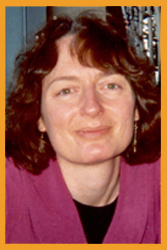
April Ossmann was the executive director of Alice James Books from 2000 - 2008. She is the author of WE (Red Hen Press, 2025), Event Boundaries and Anxious Music, both from Four Way Books, and has published poetry in numerous journals including New England Review, Harvard Review and Colorado Review, and in anthologies including From the Fishouse (Persea Books), and is the recipient of several awards for her poetry, including a 2013 Vermont Arts Council Creation Grant and a Prairie Schooner Readers' Choice Award.